
Question:
What shapes and animals did the Incas depict in the Milky Way?
Answer:
The Incas depicted a shepherd, a fox, a partridge, a toad, a serpent and a llama with a baby llama amongst other shapes in the Milky Way, which they referred to as “Mayu” (or “river”). Rather than seeing these shapes as being outlined by stars as is a well-known practice with constellations in Western astronomy, these figures were seen in the dark shaded parts of the Milky Way. Stars were still important, too. For example they denoted the two eyes of the Llama and the fox.
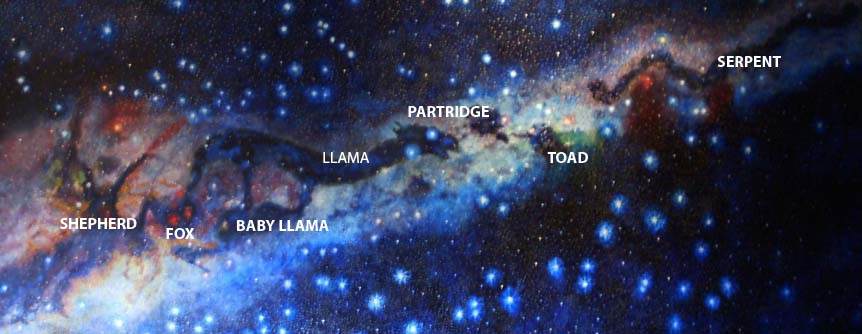
The painting above, which can be found in the Koricancha Sun Temple in Cusco, shows some of the shapes that the Incas depicted in the dark spots of the Milky Way.
The Incas and peoples before them had a very sophisticated understanding of astronomy. Many aspects of Inca buildings have been found to have be used specifically for observing the skies above, and it is known that the Incas had a very detailed knowledge of the movement of the sun, the moon and the stars in accordance with the seasons and the time of year. This was based on centuries of observation of the skies and stringent record keeping. Inca Astronomy observations were assisted by the design of specially shaped stones which can be found throughout Inca archeological sites such as Machu Picchu and Pisac.
Far from just observing the skies, the Incas judged the best time to grow crops and predicted the weather based on the positioning and brightness of stars. Their perception of the skies translated into every day life, religion and decision making.
